
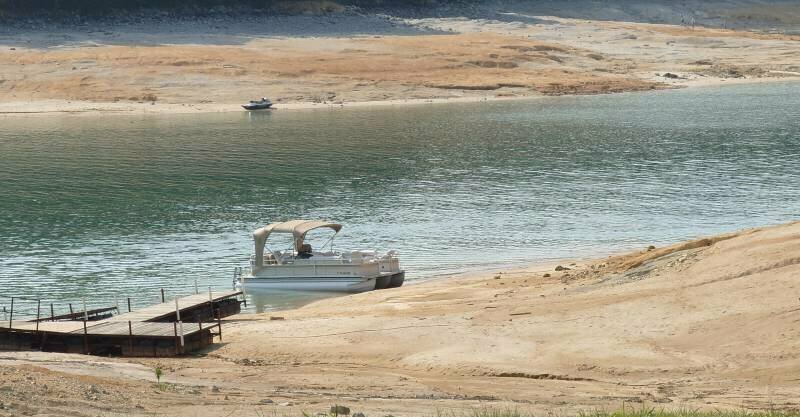
As they spoke about drought, the rain began to fall.
Outside the boardroom of the Laurens County Water & Sewer Commission board’s Tuesday morning meeting, it was a light rain. It has fallen more heavily - though wide-spread - during the week, the first relief from drought since early April. The Southeast, including South Carolina, is under a moderate drought advisory that, at one point, prompted a ban on all outdoor burning for fears that sparks would ignite nearby tinderboxes in fields and forests.
Reports to the board indicate continued growth by the Commission. It has received $23 Million in grants during the past 3 years, and has 6 grants with applications status. New water taps installed for March were 80 water and 57 sewer; 665 water taps have been installed so far this fiscal year. LCWSC billed 18,378 water customers and 2,253 sewer customers in March; that’s up 913 water customers over this time last year. The board also adopted a new policy related to the replacement of “legacy taps” for sewer service the Commission inherited when it assumed responsibility for sewerage in the Lydia Mill community of Clinton and the Joanna Mill community (2001).
The Commission’s Lake Greenwood Water Treatment Plant is producing about 2 Million gallons of pure, drinking water per day. “Right now, the lake is in good shape,” said KC Price, engineering manager. “At mid-April it was at full pond.”
Still, drought conditions are a major concern, he said. “It’s almost impossible for the farmers now,” because of early- to mid-April lack of rain.
The State measures stream-flow in gauges in South Carolina rivers, Price said, and some are at all-time lows. Some observers have found the Reedy River to be at its lowest flow-rate in 10 years, the board was told. The Congaree River, in Columbia, has sandbars.
Price said the State is working on ways to improve “citizen-science” to have people who live near rivers give real-time measurements. The water plant makes a monthly report related to Lake Greenwood, Price said.
“Like the ’07-08 and ’13-14 droughts, this one could be with us for a while,” Price said.
The SC Drought Committee was expected to issue another report April 30, and make a prediction about the drought’s length.
A recent fish kill on Lake Greenwood does not indicate that the raw water in-take into the treatment plant is contaminated, Price said. “We have looked at and monitored around our intake; there is nothing harmful,” he said. “It’s difficult to do forensics on a whole lake.”
The fish kill could be “a natural occurrence” given the lack of rain and the time of year, the board was told. “It did not affect us at the water plant,” Price said.
Ironically, May 3-9 is designated as Drinking Water Week.
In an April 30 statement, Greenwood County, Greenwood CPW and LCWSC affirmed the quality of Lake Greenwood’s water.
A published report in the Greenwood Index-Journal said authorities were notified April 13 about dead fish in the lake’s Cross Hill area. This report said State Rep. Luke Rankin (Laurens County) reported about 3,000 aquatic animals affected, adding that the fish kill seemed to “have run its course.” The State newspaper reported that in the Cross Hill area of South Lake Greenwood, crappie, yellow perch, flathead catfish, striped bass and bluegill were found dead.
No water quality issues have been found, according to the SC Department of Environmental Services. The I-J report quotes the SC Department of Natural Resources as advising, “Some of the most frequent causes of fish kills are oxygen depletion, excessive algae blooms and high water temperatures. None of these common causes have been observed with this particular fish kill.”
Fish kills can be reported to 1-800-922-5431, which is the SC DNR Fish Kill Hotline. On this line, information will be collected so that a fisheries biologist can call back to talk about fish- and water-related observations.


