
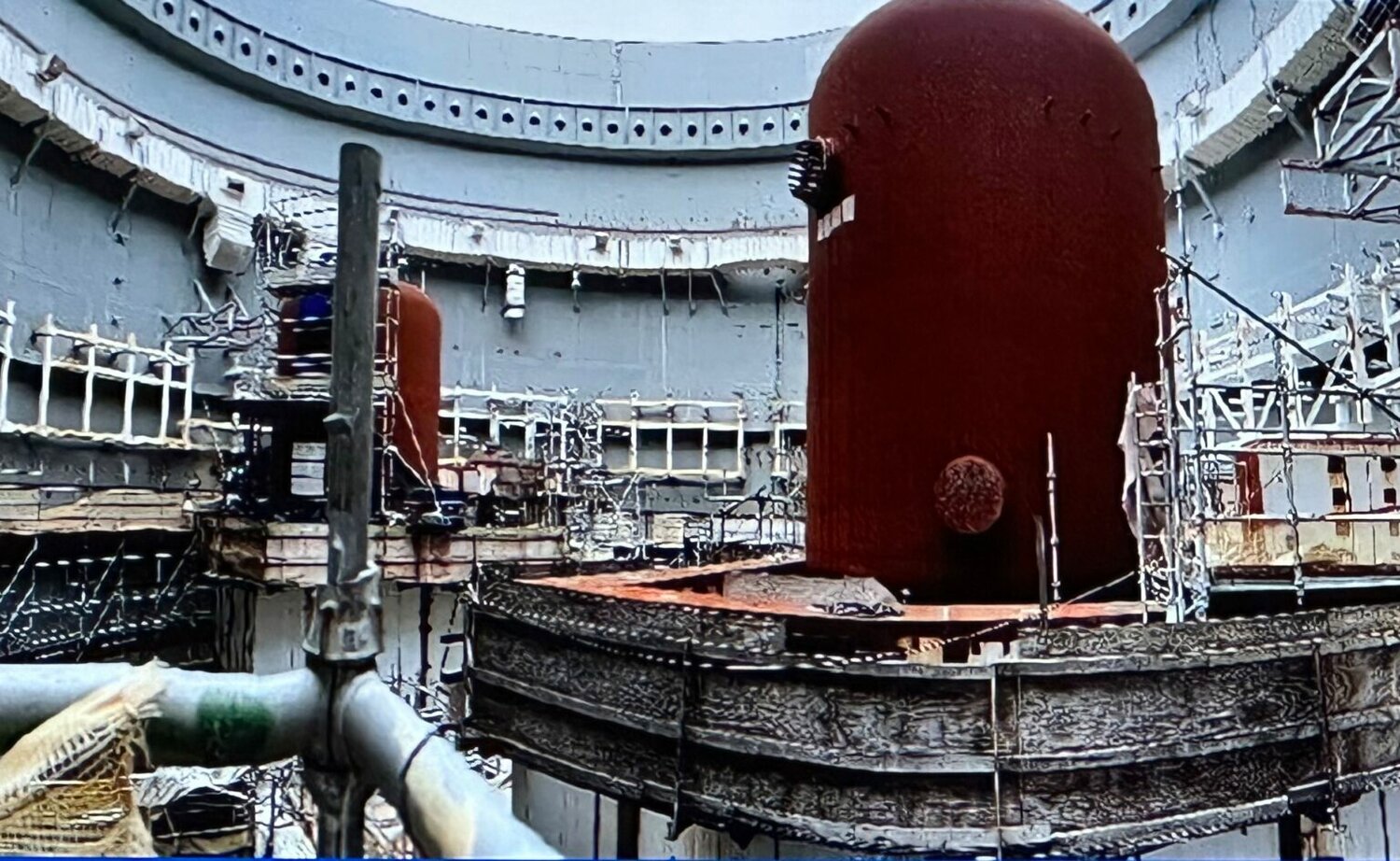
AIKEN — South Carolina’s senior senator is doubling down on his support for a potential reboot of a failed nuclear power plant expansion in the state - the plant is 34 miles south-east of Clinton.
“We don’t have enough power in this country already,” Sen. Lindsey Graham told reporters in Aiken last week to cut the ribbon on a new, $66 million nuclear research center.
“Wake up call; America needs to get back into the nuclear business,” he continued. “We need to build nuclear power plants and get them up and operating.”
His stance has only strengthened since January, when Graham told SC Public Radio he was “open to trying to revitalize” the completion of partially built nuclear reactors in Fairfield County.
State-owned utility Santee Cooper and now-defunct South Carolina Electric & Gas were partners on the V.C. Summer expansion, which was a first-of-its-kind design and marked the first new nuclear construction in the country in 40 years. When the companies abandoned the effort in 2017 — after jointly spending $9 billion — Graham unsuccessfully sought federal help to keep it going during President Donald Trump’s first term.
Last week, Graham pointed to the fraud and abuse that plagued the V.C. Summer project as the reason behind its failure.
The debacle left customers of Virginia-based Dominion Energy, which bought out SCE&G’s parent company SCANA in the aftermath, on the hook for more than $2 billion for reactors that never generated power.
Santee Cooper’s share of the debt was $3.6 billion.
Unlike South Carolina, Georgia pushed forward with its own, nearly-identical reactor, finishing it seven years late and $17 billion over budget.
Then, in October 2024, members of a state nuclear advisory group started batting around the idea of restarting the project.
In late January, Santee Cooper put out a call for a potential buyer.
U.S. Energy Secretary Chris Wright, speaking to reporters alongside Graham in Aiken last week, said he met with Gov. Henry McMaster in Washington, D.C., about the effort.
“These are plants that have got a lot of the construction already done — a lot of the engineering has already been done,” Wright said. “Can these be up and running faster and cheaper than starting from scratch? Absolutely. I think it’s a tremendous idea.”
Proponents have also pointed to revitalization efforts at other nuclear plants across the country.
A unit at the Tennessee Valley Authority’s Watts Bar nuclear plant came online in 2016, 43 years after construction began. The timeline included a 22-year gap: Work halted in 1985, then resumed in 2007.
And developers struck a deal last year to restart the remaining unit at Pennsylvania’s Three Mile Island, where a second unit suffered its notorious partial meltdown in 1979, to power a Microsoft data center.
Santee Cooper announced in May it had received some 50 proposals.
Now, those applicants are partnering off and submitting joint bids for a second round of vetting. Utility officials expect to continue the bidding process at least through February and possibly until November 2026.
“My goal is to make sure they are up and operating. We cannot lose the nuclear energy race,” Graham said. “We’ve let this atrophy. We let the whole nuclear energy footprint kind of go into the dark. We’re going to finish these reactors. Too much money has been spent, and we need the power.”
Graham took credit for negotiations that continued Biden administration tax incentives for nuclear construction.
The GOP megalaw signed by President Donald Trump last month ends tax credits for wind and solar projects years earlier than planned under Biden’s hallmark clean energy package of 2022. Under changes in the “big, beautiful” law, those projects must be up and running by the end of 2027 to qualify.
U.S. House Republicans sought to strip the credits for nuclear too. But senators, including Graham, insisted on keeping those incentives.
“I want to preserve the nuclear tax credit,” Graham said this week in Anderson. “They tried to eliminate it, do away with all the green energy. I think the nuclear tax credit is good for the environment and good for the grid. I’m hopeful by the end of the year we’ll have a new owner for those plants.”
Graham chairs the U.S. Senate Budget Committee, but he suggested the credits offer enough aid to get the project done, making taxpayer dollars through a budget earmark unnecessary.
“The tax credits make all the difference,” he said.
For nuclear energy, developers can still claim a 30% federal tax credit tax for investments through 2032. V.C. Summer would likely qualify for an additional 10% credit in the new law for “nuclear energy communities,” or sites with a history of employees in the nuclear sector.
As for the timetable, an executive order signed by Trump in May aims to speed up the licensing process.
Critics have raised concerns this could undermine safety measure. But Wright suggested safety will increase because regulators have fewer factors to consider.
“The regulations are so cumbersome and so bureaucratic, nothing gets built. And when you try to get people to focus on 200 things, you don’t get focus on anything,” he said.
Wright and Graham also touted nuclear, which does not emit greenhouse gases, as a clean source of power.
Taylor Allred, of the Coastal Conservation League, said while it’s true nuclear does not pollute the air the way fossil fuels do, it comes with other environmental risks.
The state has already experienced radioactive waste leaks, both at the federal Savannah River Site near Aiken, and at Chem Nuclear in Barnwell County, a privately owned landfill for low-level radioactive waste. The landfill has been closed to most of the nation since 2008.
Allred said opening more nuclear plants would mean more nuclear waste.
“That raises some concerns that things could get missed, and there isn’t a lot of room for error when it comes to nuclear power and radioactive waste,” he told Fox 24 News in Charleston, in a clip shared by the Coastal Conservation League. “It would be potentially devastating to our communities to start having that accelerate.”
Paul Hyde contributed to this report from Anderson.
Jessica Holdman writes about the economy, workforce and higher education. Before joining the SC Daily Gazette, she was a business reporter for The Post and Courier.
SC Daily Gazette is part of States Newsroom, the nation’s largest state-focused nonprofit news organization.


